Two shows in Southeast Asia: what operators actually asked
The World UAV Conference in Malaysia in June, INTI in Jakarta in August. Almost nobody opened with suppression figures — the first question was nearly always whether the thing fits on the platform.
Two shows, one region
The Malaysia session of the 2026 World UAV Conference opened on 25 June, gathering operators and integrators around low-altitude applications: power inspection, aerial survey, emergency response, logistics and security.
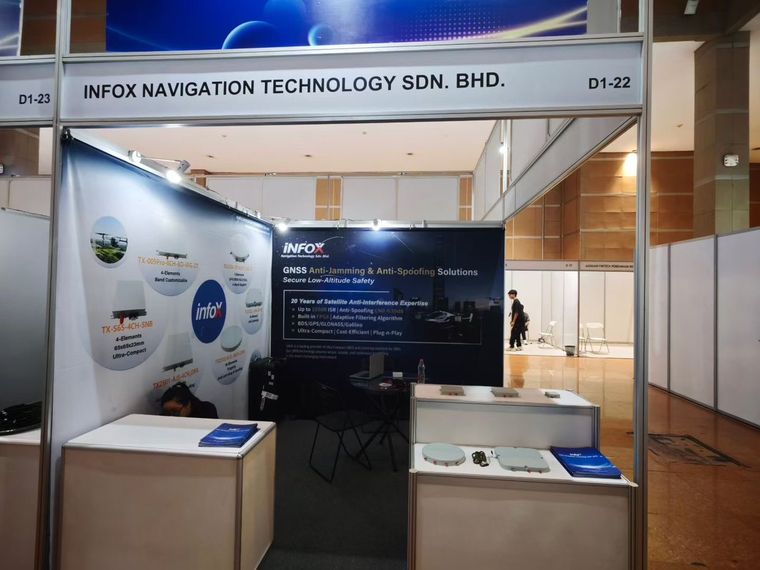
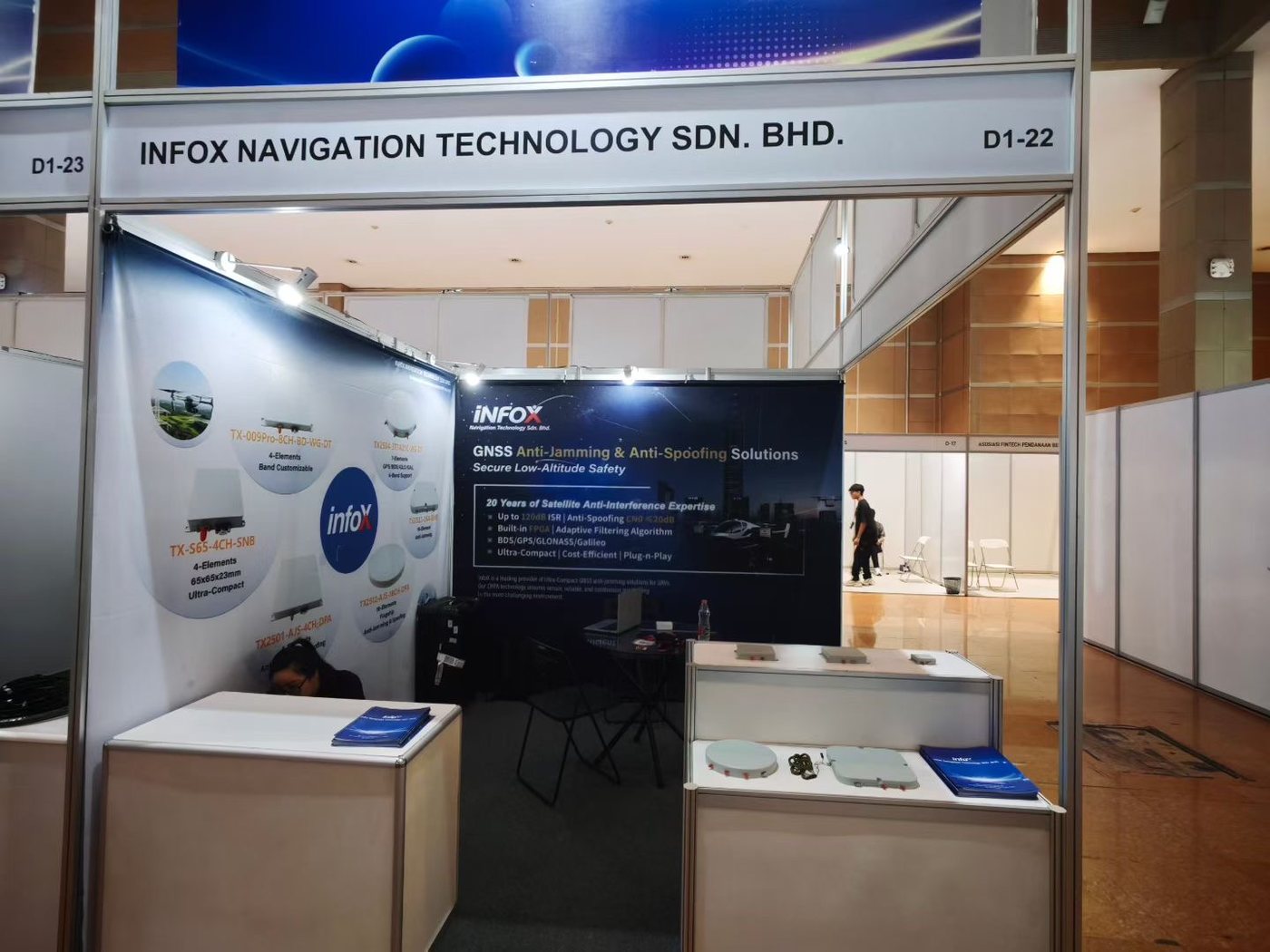
Seven weeks later we took booth D1-22 at INTI 2026 — Indonesia Technology & Innovation — at the Jakarta International Expo, 11–13 August, with the INTI Satellite Expo running alongside it. Different countries, different audiences, and by the end of the second show the same pattern in the questions.
The argument we made in Malaysia
The talk in Malaysia had one thesis: the navigation antenna has stopped being a passive part. For most of the history of commercial GNSS it was treated as a component that either received signal or did not — chosen on gain and price, specified late, rarely revisited.
In a contested or congested electromagnetic environment that assumption breaks. The antenna is the first and only place where interference can be rejected before it enters the signal chain. Once it is inside, no amount of receiver processing recovers what was lost.
Why low-altitude work exposes it
Low-altitude commercial flight concentrates every difficulty at once. Buildings block satellites and reflect signals into multipath, so the fix is already degraded before any interference arrives. Routes are flown repeatedly, on schedule, carrying value. And the platforms are small, so protection competes directly with payload.
That last constraint is why the conversation kept returning to the same trade-off — not whether protection is needed, but how much of it a given airframe can carry.
What was on the table in Jakarta
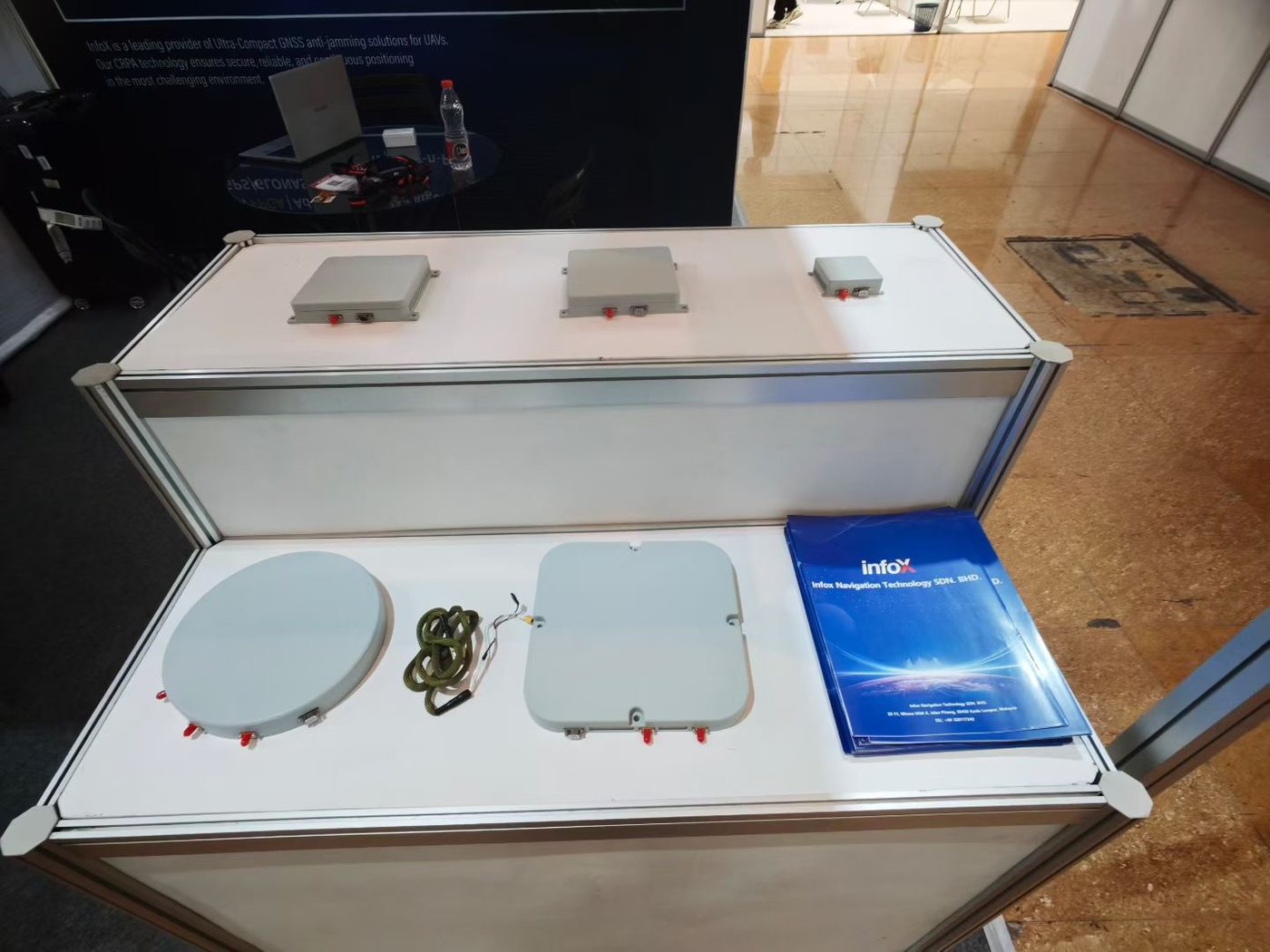
We laid the range out end to end rather than showing a hero product: the 65 mm, 130 g TX-S65-4CH-SNB next to the Ø370 mm, 2600 g TX2512-AJS-16CH-DPA, with the four-, seven- and sixteen-element models in between.
Arranging them by size does something a spec sheet cannot. The jump from a terminal you can hold between two fingers to one that needs both hands makes the trade-off physical: more elements means more nulls, and more nulls means more aperture, more weight and more power. Visitors understood the constraint in about four seconds.
The questions that actually came up
Almost nobody opened with suppression figures. The first question was nearly always some version of “will this fit on my platform” — payload budget, mounting area, available power, and whether the output drops into an existing receiver without a redesign.
The second question was about the environment, and it was more specific than we expected. Operators flying near ports, industrial sites and dense urban areas were not asking about hypothetical attacks. They were describing degraded fixes they already see, and asking what would restore them.

What the questions map to
| What they asked first | What it actually decides |
|---|---|
| “How heavy is it?” | Element count, settled by the airframe before anything else |
| “How much power?” | 6 W and 40 W are different design conversations |
| “Will my receiver take it?” | −70 to −60 dBm into 50 Ω, agreed at design time |
| “Does it handle spoofing too?” | Two of the eight models add that; the rest do not |
Where this leaves us
Southeast Asian operators are past asking whether GNSS interference is a real problem. They are asking which protection they can actually carry, and what it costs them in grams and watts. That is a procurement conversation, not an awareness one — and it is the conversation the range was built for.
If you met us at either show and want the numbers we talked through, the full comparison table is on this site, and we answer inquiries within one business day.